Choices to make
Coffins: types, materials and what they cost
It is one of the first questions you will be asked and nobody has practice at it. Here is what the options actually are, what they cost, and what the rules really say.
What actually has to be decided
Very little, and less urgently than the arrangement meeting will make it feel. A basic coffin is included in every funeral director’s standard price. If you choose nothing at all, the funeral goes ahead in a veneered board coffin and no one at the crematorium will think anything of it.
Everything above that is a choice, and the useful questions are:
- Burial or cremation? It narrows the field. Natural burial rules out varnished board; cremation rules out shrouds and metal.
- Is anybody carrying it? A solid oak casket is very heavy. Bearers are usually the funeral director’s staff, but if the family want to carry it themselves — and many do — the weight matters more than the finish.
- Does it need to mean something? A printed or decorated coffin can be the most personal object at the whole funeral. Or it can be entirely beside the point. Both answers are common.
What the law says, and what it does not
There is no legal requirement anywhere in the UK to use a coffin. What the law requires is that a body is disposed of decently and lawfully, by burial or cremation, with the correct authority from the registrar or the coroner.
What does the actual constraining is the crematorium’s or burial ground’s own rules — private conditions of a contract, not statute. Crematoria require a rigid, combustible container because of what they have to operate safely. Natural burial grounds require biodegradable materials because that is the point of them. Council cemeteries are the most permissive of all and will bury almost anything.
Buying direct
Coffins can be bought from UK suppliers online, delivered to your home or to the funeral director, and used for an otherwise ordinary funeral. Willow, cardboard and painted coffins in particular are often much cheaper this way.
Two practical points. Tell the funeral director early, because they need to know the dimensions and delivery date. And expect a handling charge from some firms — that is reasonable, since it is work they would otherwise have priced into the coffin.
Making one
It is entirely lawful to build a coffin, and a few families do — usually where the person who died was a joiner, or where a son or daughter wants something to do with their hands in the worst week of their life. Crematoria and burial grounds will accept a home-made coffin provided it is sound, has adequate handles, and meets their material rules. Ring them first, tell them what you intend, and ask for their dimensions in writing.
Related: what a funeral costs , burial or cremation , and urns and scatter tubes for what happens after a cremation.
The main types
Coffins in the UK, and what each costs
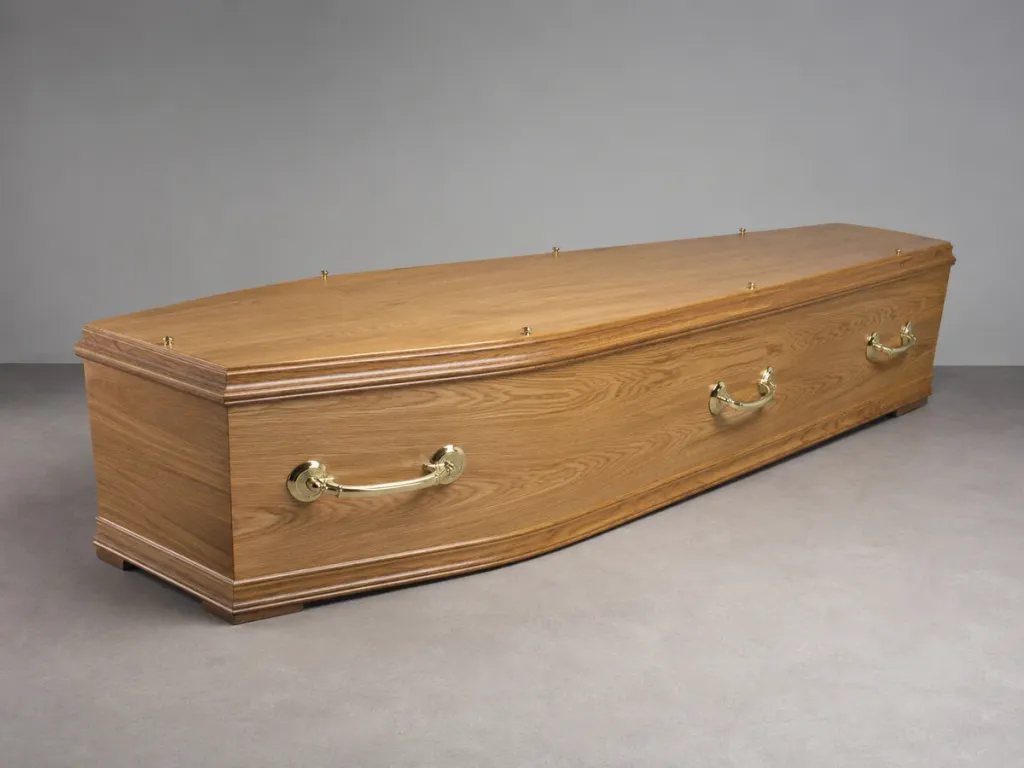
Usually included
Veneered chipboard or MDF
The standard coffin included in most funeral directors' basic fee — a wood-effect veneer over a manufactured board, with a gloss finish and moulded handles.
- Included as standard almost everywhere
- Suitable for burial and cremation
- The handles are usually plastic, not metal
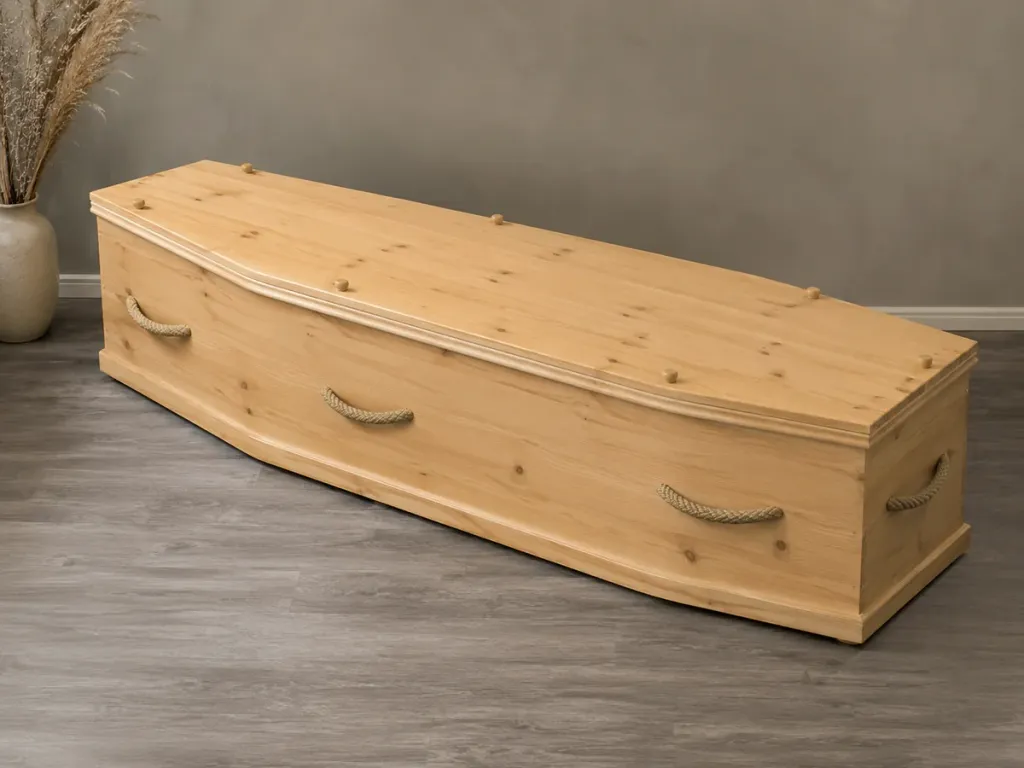
£150 – £400 extra
Solid pine
A plain softwood coffin, sometimes waxed rather than varnished. Often chosen by people who want something honest-looking rather than glossy.
- Suitable for burial and cremation
- Accepted by most natural burial grounds
- Lighter than hardwood
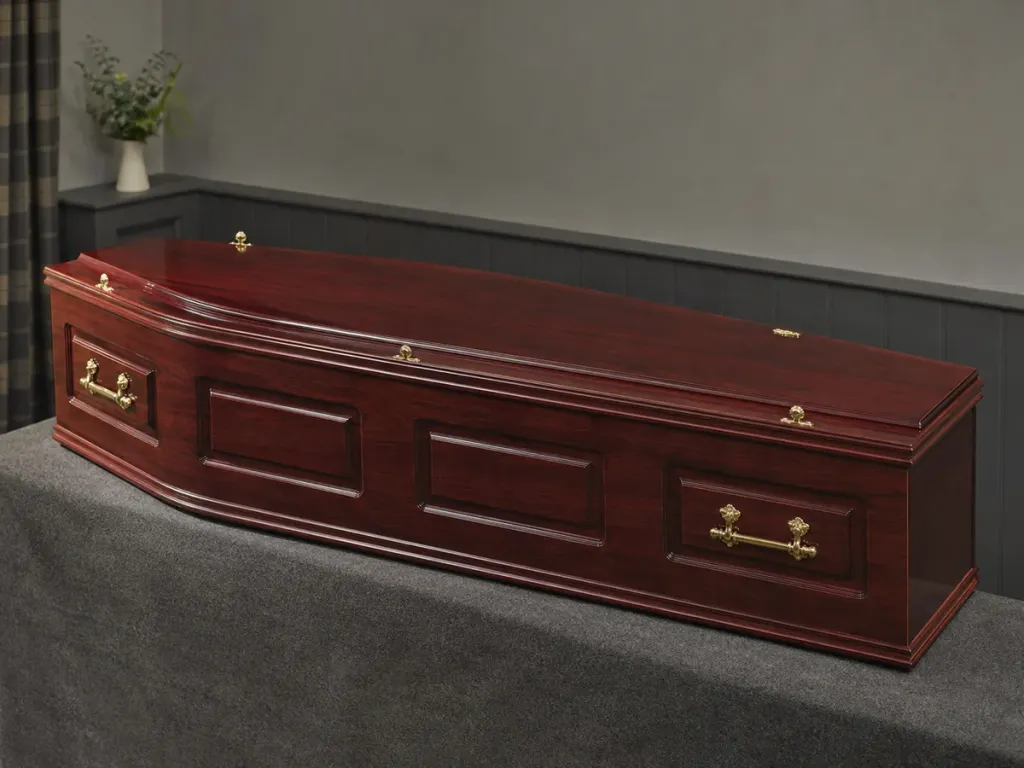
£300 – £600 extra
Veneered oak or mahogany
The traditional funeral coffin: a hardwood veneer with solid mouldings, panelled sides and a raised lid. What most people picture when they picture a coffin.
- Suitable for burial and cremation
- Wide range of finishes and fittings
- Solid timber versions cost considerably more
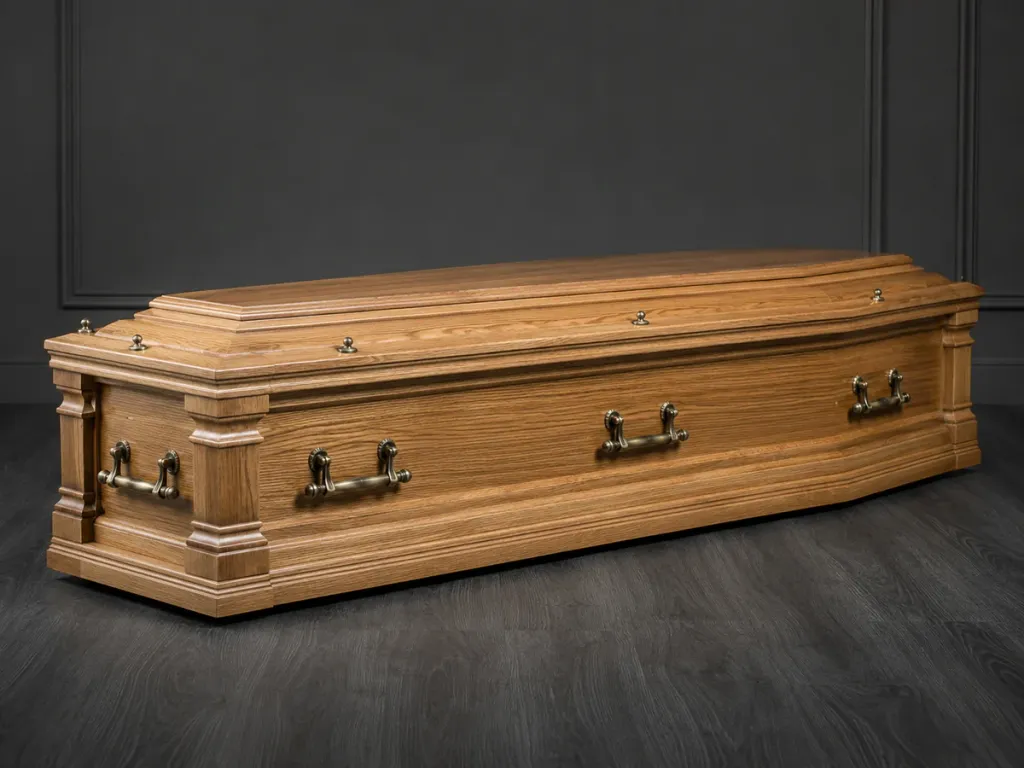
£700 – £1,500 extra
Solid oak casket
Solid hardwood throughout, usually rectangular rather than tapered. The most expensive conventional option and by some distance the heaviest.
- Traditionally associated with burial
- Needs more bearers
- Not accepted by some natural burial grounds
£400 – £900 extra
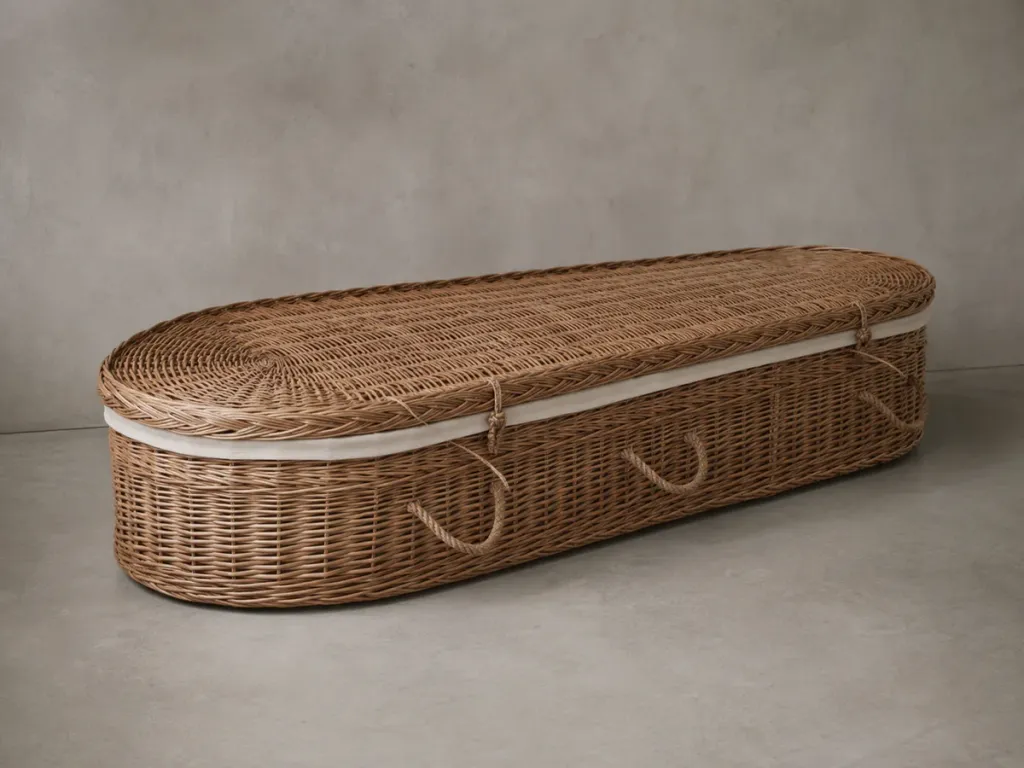
Willow, wicker or seagrass
Woven from willow, bamboo, seagrass or banana leaf. Comes with a cotton lining and, usually, a matching quilt and pillow.
- Fully biodegradable
- Accepted at natural burial grounds
- Suitable for cremation
- Oval and rectangular shapes available
£100 – £350 extra
Cardboard
Strong, laminated cardboard, sometimes plain and sometimes printed. The lowest-cost and lowest-impact option, and one families often decorate themselves.
- Fully biodegradable
- Can be drawn or written on by children and mourners
- Lightest of all types
- Check the burial ground accepts it — nearly all do
£250 – £600 extra
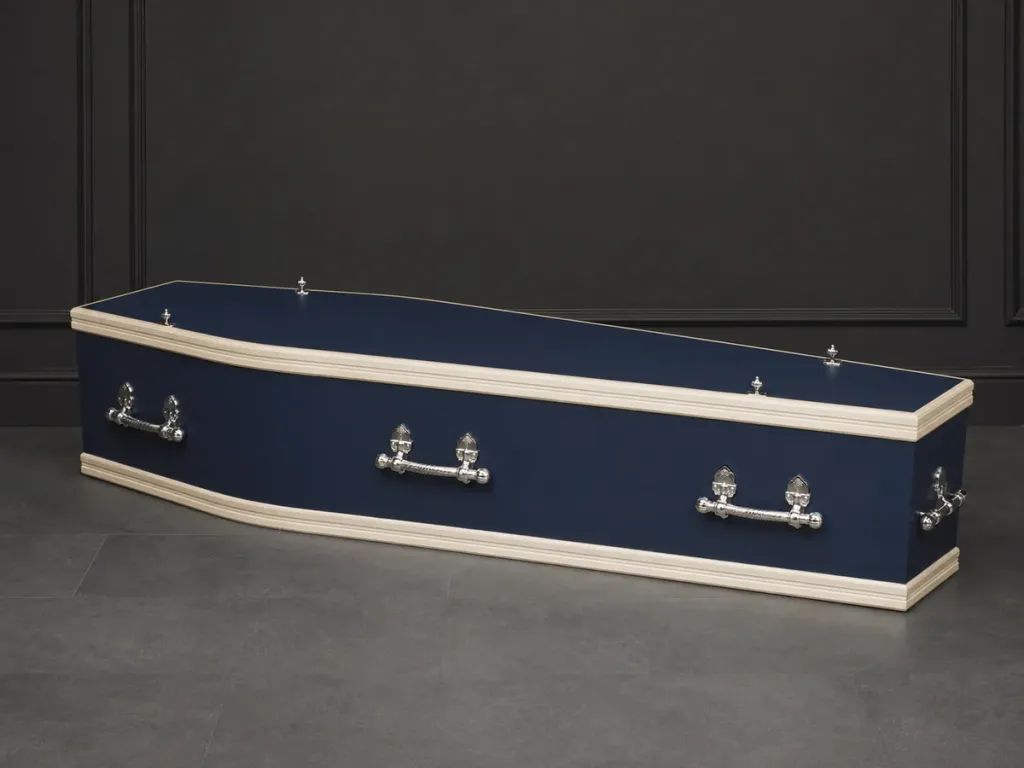
Painted or coloured
A sprayed board coffin in any colour: a football team's colours, a favourite shade, a regimental blue.
- Suitable for burial and cremation
- Almost any colour to order
- Usually needs about a week's notice
£450 – £900 extra
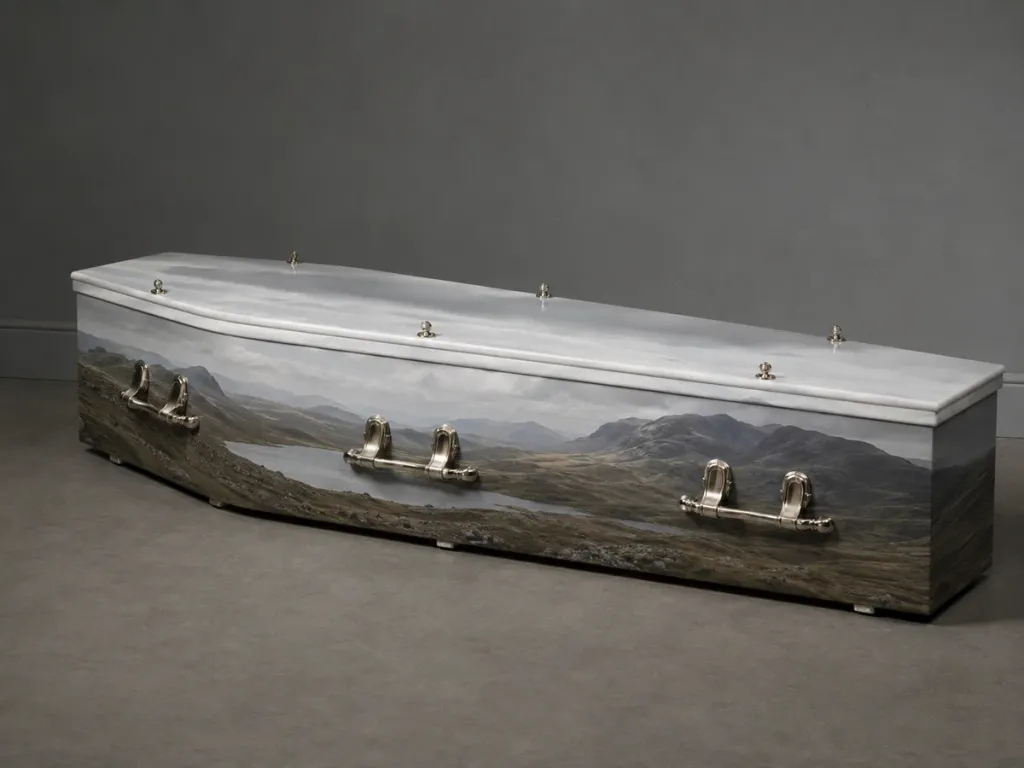
Picture or photographic
Printed to order with photographs or an image — a landscape, a garden, a boat, a football ground. Usually printed onto a biodegradable board.
- Made to order from your own images
- Suitable for burial and cremation
- Allow one to two weeks
£100 – £400
Shroud
A wool or cotton shroud on a carrying board, with no coffin at all. Lawful in the UK and used mainly for natural burial.
- Not usually accepted for cremation
- Accepted at most natural burial grounds
- Ask the burial ground before committing
Prices are the typical UK extra over the basic coffin that a funeral director includes in the professional fee — not the total cost of the funeral. Firms differ, so ask what is included before comparing anything.
A coffin is not legally required
There is no law in England, Wales, Scotland or Northern Ireland requiring a coffin. What is required is decent, lawful disposal — and crematoria and burial grounds set their own practical conditions.
You can buy one yourself
Coffins can be bought direct from suppliers online and delivered to the funeral director. Some firms charge a handling fee; a firm that refuses outright is worth asking why.
Ask the burial ground first
Natural burial grounds have their own rules — usually no varnish, no metal fittings, no chipboard. Check theirs before ordering anything.
Questions people ask us most
Is a coffin included in the funeral price?
Is a coffin legally required in the UK?
Which coffins can be used for cremation?
Can I buy a coffin myself instead of through the funeral director?
What is a natural burial ground going to accept?
Can a coffin be personalised?
You do not have to work this out in one sitting
Very little has to be done on the first day, and almost nothing has to be decided tonight. Start with the step-by-step guide, and if you need a person rather than a page, the helplines are free and answered by people who do this every day.